Carbon steel: keen edge, dry after each use.
Japanese chef's knife: all-round for vegetables, meat and fish.
Long: big boards, large vegetables, pro or enthusiast use.
At 210 mm, this double-bevel kiritsuke combines a long profile with a k-tip point, cut at an angled bevel. The blade handles vegetables, meat and fish, while the tip is used for precise cuts and detail work. The name, which evokes the idea of cutting with precision, points to that use. Within the usual 210 to 270 mm range, this length sits at the most compact end.
The sanmai construction pairs a hagane core with jigane cladding on both sides. The hard hagane is thinned down to the cutting edge, while the softer jigane supports the blade behind the edge. On a long profile like the kiritsuke's, this arrangement keeps the hardness at the edge and the strength in the rest of the blade. The handle is Kuroro, paired with this 210 mm blade.
The core steel is Aogami #1 (Blue Steel #1), a carbon steel with added chromium and tungsten, and not stainless. Its carbon content of 1.25 to 1.35% and hardness of 63 to 65 HRC give it edge retention higher than Aogami #2, with slightly lower toughness. On stones, it takes more passes than Shirogami, and the edge it reaches lasts a long time. The core reacts to oxidation and develops a patina. Shirogami sharpens faster, while Aogami #1 holds its edge longer: the choice depends on maintenance habits.
Care
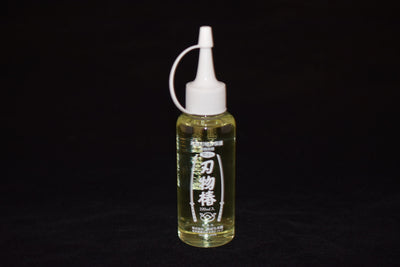
Wipe and dry the blade immediately after each use; a patina develops over time, which is normal. Use camellia oil for extended storage, and never put it in the dishwasher.