Carbon steel: keen edge, dry after each use.
Japanese chef's knife: all-round for vegetables, meat and fish.
Long: big boards, large vegetables, pro or enthusiast use.
At 240 mm, this kiritsuke in Shirogami #2 pairs a long profile with a k-tip point, the angled tip that defines this knife type. The blade length suits long slicing strokes on vegetables, meat and fish, and the tip handles detail work. The blade is double-bevel (ryoba). The name means "applied cut": the tip calls for a precise motion, especially on fine work.
The handle is finished in urushi, the traditional Japanese lacquer made from the sap of the lacquer tree. Applied in successive layers, it hardens to form the surface of the handle. On a 240 mm blade meant for long slicing strokes, this lacquered handle calls for one simple precaution: avoid prolonged soaking and the dishwasher, which damage the lacquer.
The steel is Shirogami #2 (White Steel #2), a non-stainless carbon steel from Hitachi (Proterial), named after the colour of its factory wrapping paper. With no chromium or tungsten, it reacts to moisture and develops a patina quickly. It takes a very acute edge, and the edge responds readily to a whetstone: a few passes are enough to restore sharpness. Blade geometry, more than steel alone, determines how much resistance the knife meets in food. The steel allows an acute angle and holds it. It is also less brittle than Shirogami #1.
Care
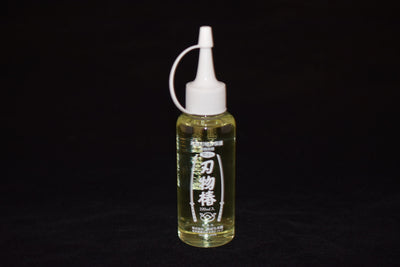
Wipe the blade immediately after each use and dry it completely. A grey patina will form over time, which is normal. For extended storage, apply a thin film of camellia oil. Never wash in the dishwasher.